Platform
One engine. Five surfaces.
No second source of truth.
myrevai is not five tools with a shared logo. It is one data model and one decision loop, exposed through the five places you need to look — and built so every automated judgement is inspectable and reversible.
- Loop
- Ingest → observe → decide → approve → measure
- Default autonomy
- None. Suggestions only.
- Isolation
- Per-account on every query
- Locale
- ₹ · IST · DD/MM/YYYY
The loop
How a booking becomes a better price.
Each stage feeds the next, and the last stage grades the third. That closed loop is the whole design — it is what separates a pricing engine from a pricing opinion.
Ingest
Bookings, room types, rates, channels, guests and charges arrive from your PMS, channel manager, the REST API or a CSV. One canonical record per booking — every module reads from it.
Observe the market
myEDGE AI refreshes the comp set: live competitor rates, availability, discounting and OTA presence, converted to rupees. Local events and festivals are collected alongside.
Decide
aiREV combines six weighted signals into a recommended rate per room type per date, clamps it to your bounds, attaches a reason and a confidence score.
Approve
You review. Selected recommendations become dated rate overrides; the rest expire. Every applied change is written to the pricing audit log.
Measure
The Revenue Dashboard computes what happened, Profit Analysis computes what it left behind, and forecast accuracy is logged against real room-nights sold.
Stage 01 in the product
Observe the market, decide the rate, measure what happened — over one set of numbers.
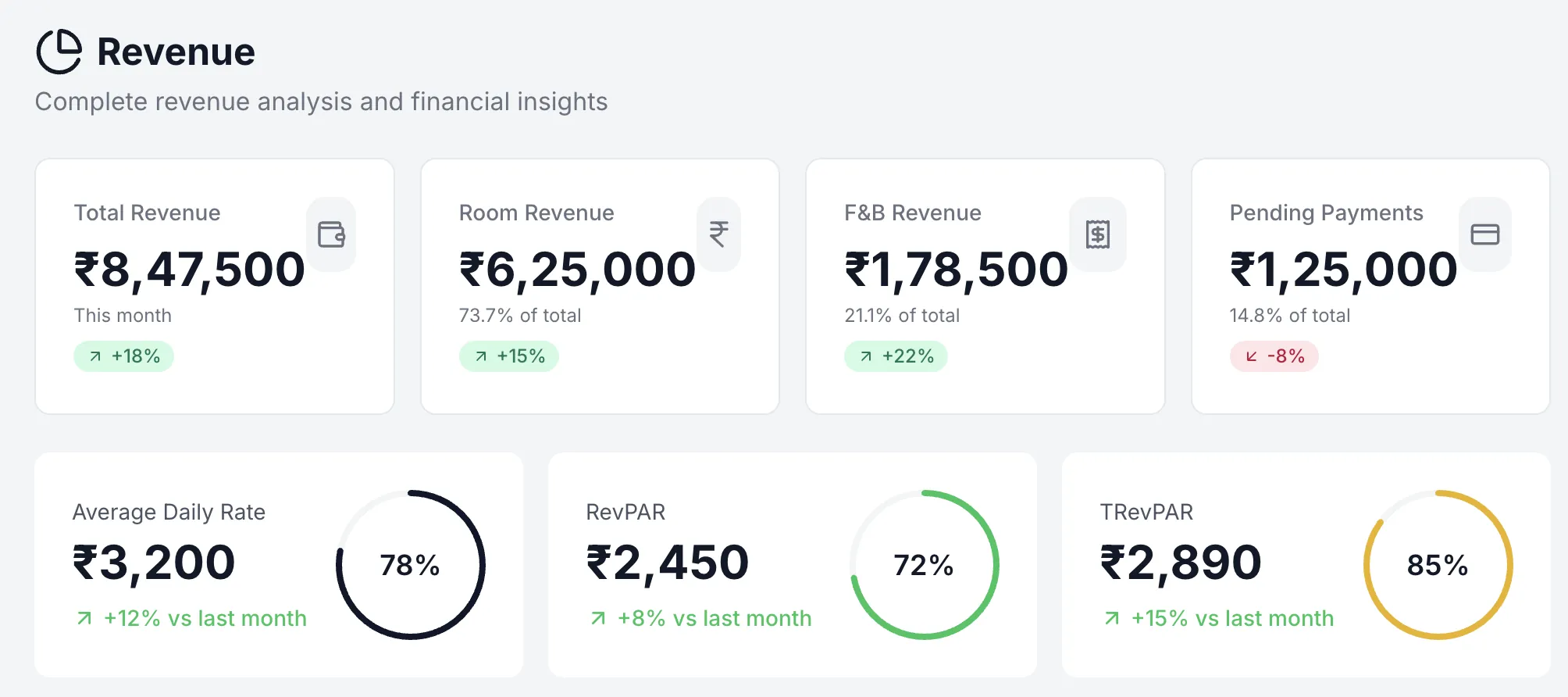
Measured
Revenue split by room and F&B with pending payments held apart, then ADR, RevPAR and TRevPAR — computed on sold and available room-nights, not on booking counts.
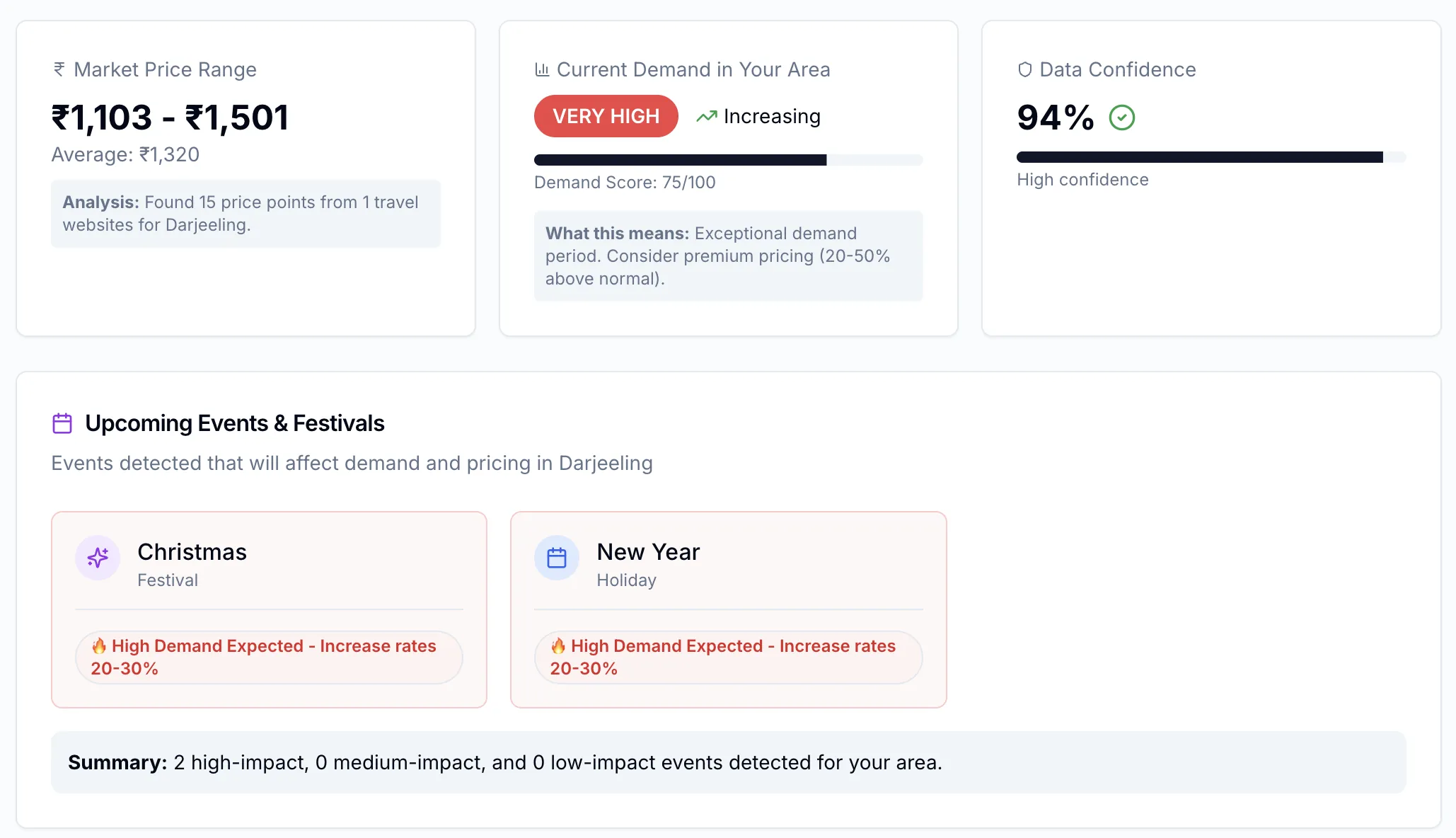
Observed
The market price range for your area, a demand score with its direction, a data-confidence figure, and the events that will move the coming weeks.
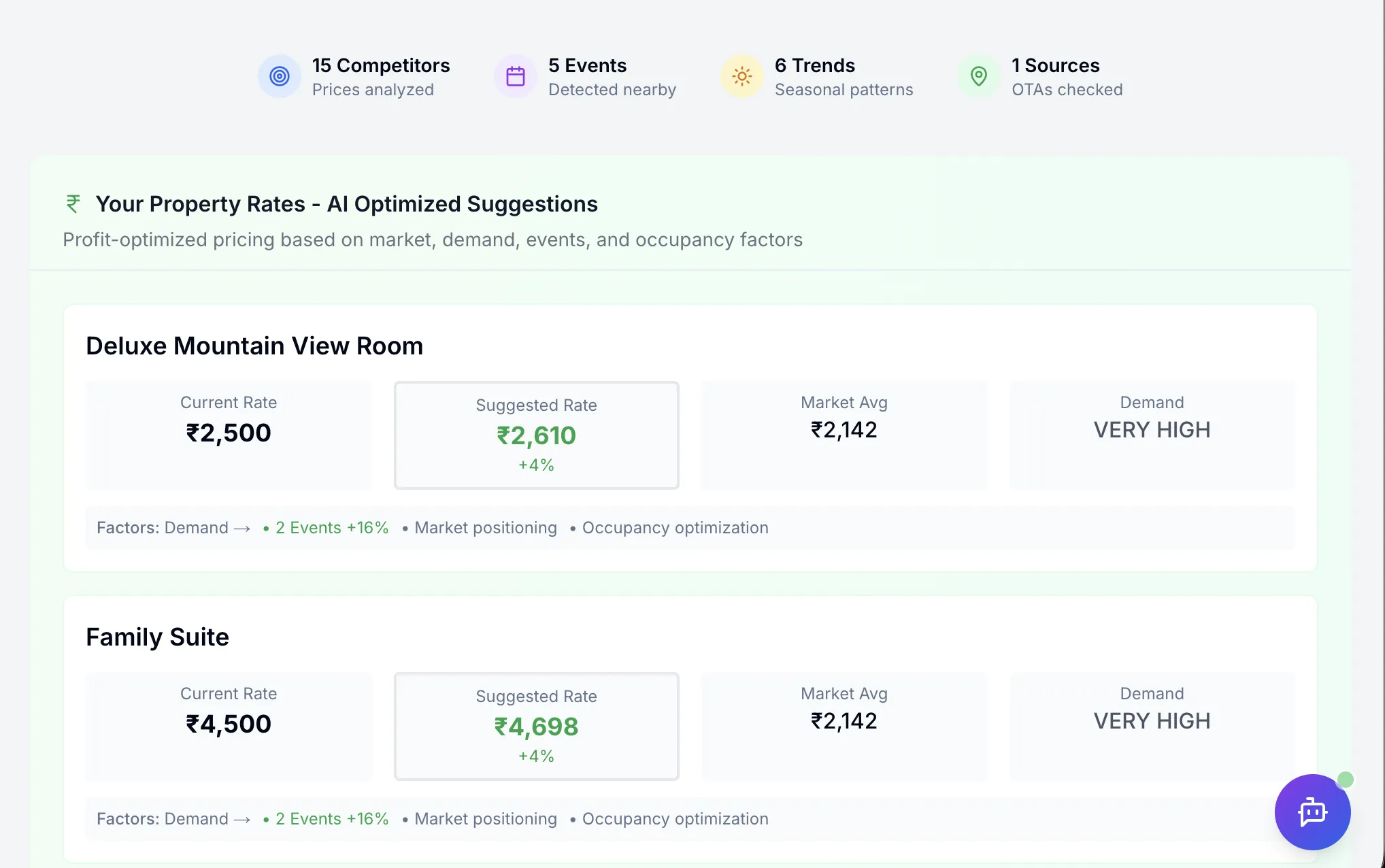
Decided
Current rate, suggested rate, market average and demand level per room type — with the factors that produced the suggestion named alongside it.
The AI layer
Two systems, deliberately separated.
A deterministic pricing core you can audit line by line, and a language-model layer that does the parts arithmetic cannot: reading the market, spotting what you did not ask about, and explaining the result in a sentence.
What the models actually do
Reason over the whole picture
The daily pass runs on a reasoning model that works through ninety days of bookings, the live comp set, the event calendar and your rate structure in steps — then states what matters and why.
Turn language into signal
Competitor listings, amenity lists, deal text and event descriptions are prose. A long-context model reads the entire comp set in one pass and returns a structured market position.
Write the explanation
Every recommendation gets a plain-English rationale, and every analysis an executive summary, ranked insights and an ordered list of immediate actions.
Answer follow-up questions
myhomeAI takes the same context into conversation, so any number on any screen can be interrogated rather than merely displayed.
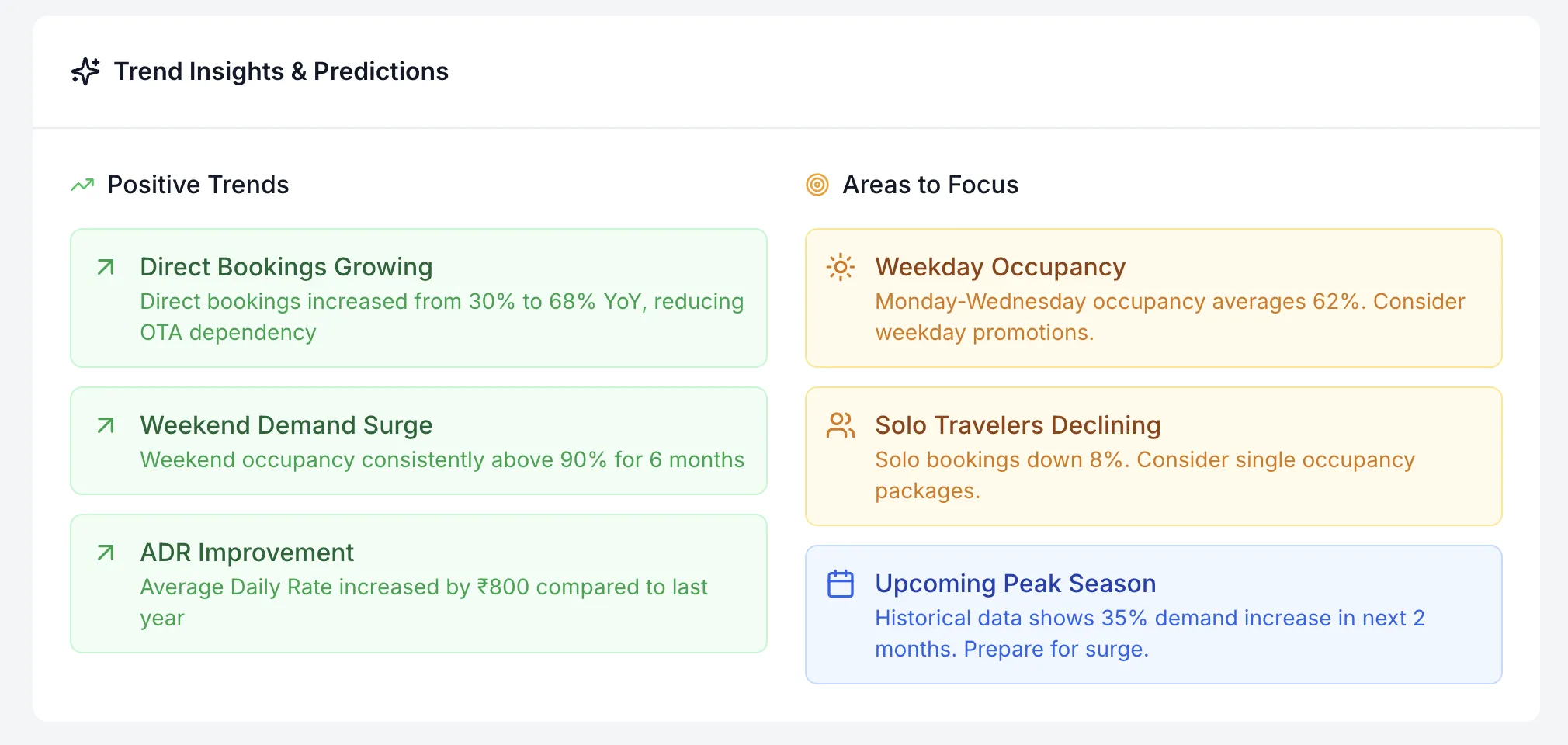
Multi-step reasoning over your full booking history
Large context — the entire comp set in one pass
Fast and conversational, streamed token by token
Disciplined strict-JSON output, schema validated
Reliable workhorse when a primary model is unavailable
Each purpose has an ordered fallback chain. A retired model or a rate limit rolls to the next one automatically — the analysis still lands at 06:00.
Routed by purpose, guarded by schema
Reasoning, long-context analysis, conversation and strict JSON generation are different jobs, so they route to different models through one gateway. Each purpose carries an ordered fallback chain — a retired model or a rate limit rolls to the next one and the analysis still lands on time.
Structured output, validated
Responses are parsed against a schema. Malformed output is rejected and retried rather than rendered as fact.
Reasoning traces stripped
A reasoning model's internal working is removed before anything is stored or shown. You get the conclusion, not the scratchpad.
Scheduled, not reactive
Market data refreshes each morning; the AI analysis follows at 06:00 IST. On-demand runs are available when something changes.
Graded on outcomes
Forecast accuracy is logged against actual room-nights sold, so the engine's record is measurable rather than asserted.
The deterministic core
The number itself comes from published maths.
We could put the rate entirely in the model's hands and call it magic. We do not. The AI decides what matters and argues for a course of action; the rate is produced by a formula whose weights are published, whose factors are visible, and whose output is clamped to a floor and ceiling you control.
The signals are multiplied as weighted powers rather than added, so no single input can run away with the price. Intelligence on top, auditability underneath — that separation is the reason a recommendation can be argued with.
Occupancy on the date + 90-day booking history
Month factor, 0.70 monsoon → 1.30 December
Saturday 1.20, Friday 1.15, Mon–Tue 0.90
Festivals and local events near the property
Last-minute premium, early-bird discount
Live competitor rates from myEDGE AI
rate = base × demand.30 × season.20 × dow.15 × event.15 × lead.10 × comp.10
Guardrails
The parts we built to constrain ourselves.
An engine that can change your prices and spend your money needs limits that are structural, not a matter of good intentions.
Suggestion-only default
Auto-pricing is off until explicitly enabled per property. Until then, no rate changes without a human selecting it.
Kill switches that actually stop spend
Disable a module for one property, for the feature globally, or with a master switch. The check runs before the provider call, so a disabled feature costs nothing.
Quotas counted honestly
External API usage is counted from recorded calls, not from a proxy that deduplicates repeats — a shared paid quota cannot be drained unnoticed.
Tenant isolation
Every read is scoped to the owning account and verified against property ownership before any data is returned.
Bounded output
Recommendations are clamped to 0.65×–2.00× the base rate, or to the floor and ceiling you set per room type.
Audit trail
Applied rate changes record the old rate, the new rate, the date range, the room type and the reason given at the time.
- Kill switch
- 3 levels
- External data quotas
- 2
- Confidence cap
- 95%
- Silent rate changes
- 0
Property · feature · platform
Daily and monthly, both enforced
Never claims more than it has
By construction, not by policy
Locale
Built for the Indian market, not translated into it.
The seasonality curve peaks in December and bottoms in the monsoon. Days roll at IST midnight, so a daily budget and a daily report mean the same day. Money is rupees everywhere — competitor prices that arrive in dollars are converted before they are compared, never after.
Guest data handling is designed with India's data protection regime in mind: clear separation between the data a property controls and the data the platform processes for its own purposes, with the lawful basis for each documented.
Currency
₹, with lakh-scale formatting. USD sources converted at a cached daily rate.
Time zone
Asia/Kolkata. Daily jobs, budgets and reporting periods all roll at IST midnight.
Dates
DD/MM/YYYY throughout the product and in every AI response.
Season curve
Dec 1.30 peak, Oct–Nov festival and wedding season, Jul–Aug monsoon trough at 0.70.
Deployment
An analysis layer, not a booking system.
myrevai is an independent product that does one thing: AI revenue analysis. It does not take reservations, hold inventory, issue confirmations or process payments — your property management system, channel manager and booking engine keep doing all of that. myrevai reads from them, reasons about what it finds, and hands back rate recommendations for you to approve.
If your data lives somewhere we do not yet sync with, the REST API and CSV import are first-class paths, not fallbacks. A property can be producing recommendations from a booking export on the first afternoon.
See it run on your own numbers.
Bring 90 days of booking history. We will show you the rate recommendations, the comp set, and the profit waterfall it produces — before you commit to anything.