Every rate comes
with its reasoning.
Built for resorts, boutique properties and small-to-mid-size hotels across India. myrevai prices the room, reads the market and shows you what you actually keep — five modules, one engine, and not a single number you can't trace back to the signal that produced it.
- 6
- Pricing signals
- 0
- Auto-applied changes
- Daily
- Analysis cadence
Valley View Deluxe
Event: Christmas week · weekend premium
confidence 88%Garden Suite
Peak season · high demand (82/100)
confidence 84%Courtyard Twin
Low demand — attract bookings
confidence 71%Terrace Room
Monsoon off-season adjustment
confidence 66%Nothing changes until you select rows and apply them.
Apply selected- RevPAR
- ₹2,061
- ADR
- ₹3,029
- Occupancy
- 68.1%
- TRevPAR
- ₹2,339
- MPI
- 104
- Direct share
- 41%
+11.4%
+6.2%
+4.8 pts
+9.1%
vs comp set
+7.0 pts
What the engine does
The problem
Resorts and hotels don't underprice by choice.
Whether it is a 90-room resort or an eight-key boutique villa, the same three gaps show up — and they compound over a season.
The market is invisible
You find out a neighbour dropped their December rate when your weekend doesn't fill. By then the booking window has closed.
One base rate, all year
A single rate can't hold a Diwali Saturday and a monsoon Tuesday. Changing it manually across every room type is a weekly chore nobody does.
Revenue isn't profit
A record month on OTAs can net less than a quiet one that sold direct. Commission is invisible until you subtract it deliberately.
The product
Five modules that share one set of numbers.
Each one stands on its own. Together they close the loop: myEDGE reads the market, aiREV turns it into rates, the Dashboard measures what happened, Profit Analysis tells you what survived, and myhomeAI answers questions about all of it.
AI revenue manager
aiREV
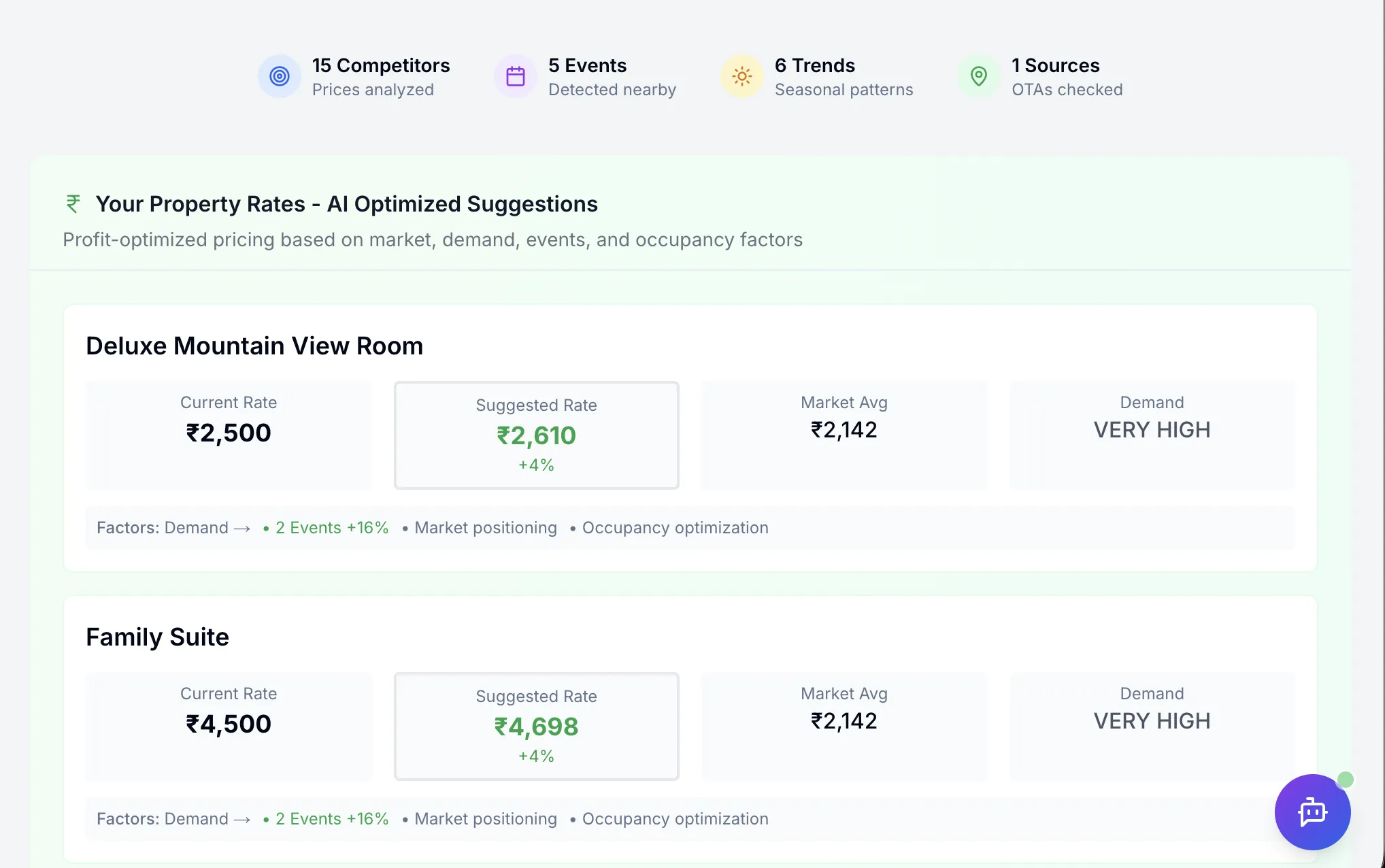
AI-optimised rate suggestions for every room type, with the current rate, the market average, the demand level and the factors that moved the number — side by side.
- Suggested rate vs current rate vs market average
- Factors named: demand, events, market positioning, occupancy
- Suggestions only — you apply what you agree with
Competitive intelligence
myEDGE AI
Competitor rates from up to 15 similar properties in your area, with market average, demand score, data confidence and the events that will move pricing.
- How you compare to the market, with a clear verdict
- Upcoming events and festivals with rate guidance
- Analysis periods from this week to next month
Conversational analyst
myhomeAI
Ask about your own business in English, Hindi or Bengali and get an answer from your live bookings, channels, guests and rates — in about two seconds.
- Suggested questions to start, free text for the rest
- Three languages, with voice input
- A visible monthly message allowance
Complete revenue analysis
Revenue Dashboard
Total, room and F&B revenue with ADR, RevPAR and TRevPAR, pending payments, and historical performance trends against last year.
- ADR, RevPAR and TRevPAR with month-on-month change
- Revenue split by room, F&B and channel
- Year-on-year occupancy and booking growth
What you actually keep
Profit Analysis
The revenue waterfall from gross to net: OTA commission, platform fees and operating cost, then GOPPAR, CPOR and NRevPAR by channel and room type.
- Commission cost and direct-booking savings, per channel
- Profitability by room type, not just revenue
- Monthly profit trend over 30d / 90d / 12m
One engine
Buy the module you need. The rest is already wired.
Competitor rates flow into pricing. Applied rates flow into the dashboard. Commission flows into profit. You never reconcile two sources of truth.
The AI layer
A revenue analyst that reads everything, every morning.
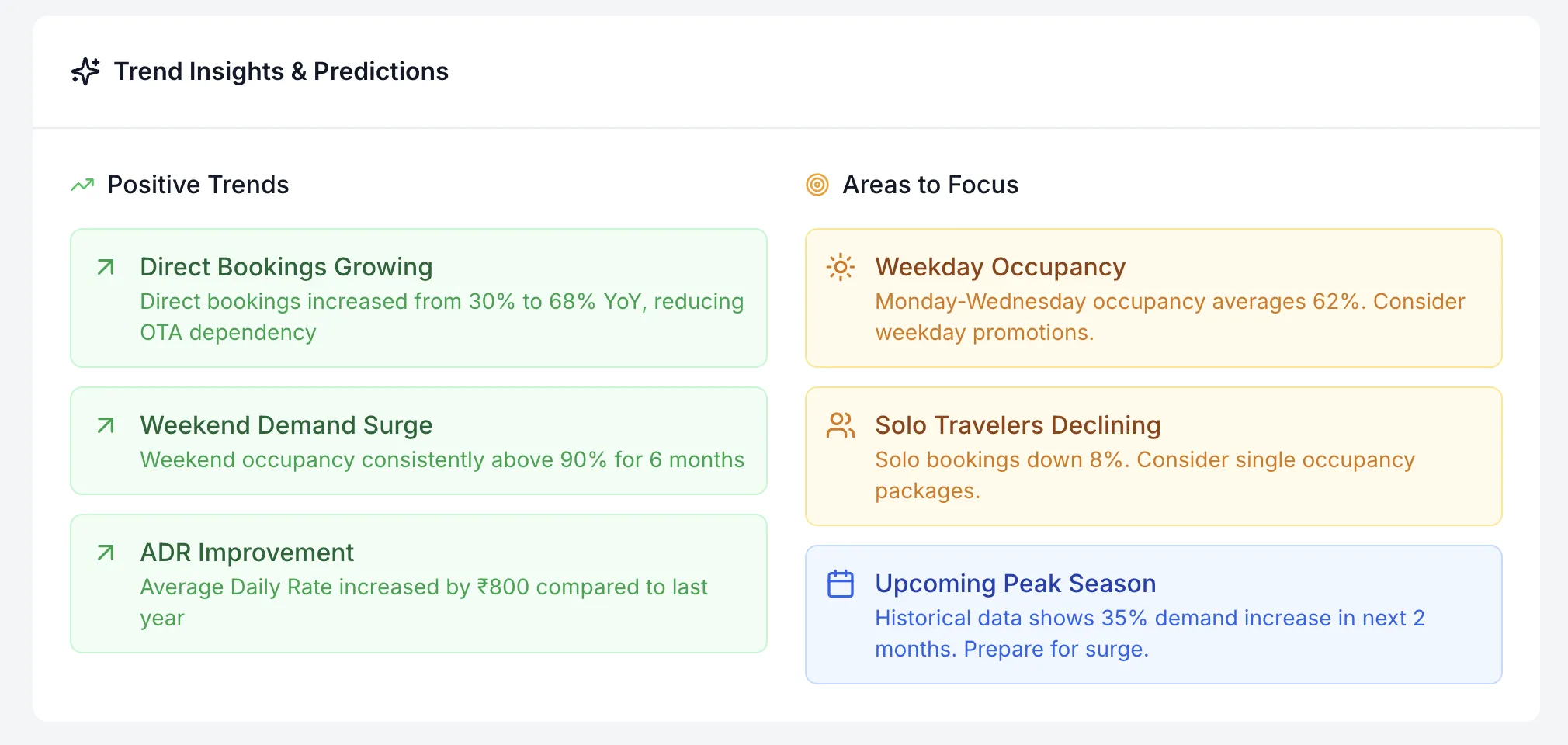
A spreadsheet can compute RevPAR. It cannot read five competitor listings, notice that two are discounting into your best weekend, connect that to a festival three weeks out, and tell you which of your room types is exposed. That is what the AI pass does — every day, before you open the dashboard.
It works over your live data: ninety days of bookings, your rate structure, your channel mix, live competitor pricing, and local event signals pulled from the open web. What comes back is an executive summary, ranked insights, and a short list of actions with the numbers attached.
Reasoning, not autocomplete
Pricing analysis runs on a reasoning model that works through the problem in steps, rather than a chat model asked to sound confident.
Reads the market in language
Competitor listings, amenity lists, deal text and event descriptions are unstructured. The AI turns them into a position you can price against.
Finds what you didn't ask about
Shortening lead times, a room type pricing itself out of its segment, direct growth that is really just repeat guests — patterns nobody thought to query.
Explains itself in English
Every rate change carries a plain-language rationale, and myhomeAI will expand on any of it in conversation.
Different models for different jobs — and a deterministic core underneath.
Reasoning, long-context analysis, conversation and strict structured output are not the same task, so they do not go to the same model. Each purpose routes to the model suited to it, through one gateway, with an ordered fallback chain.
The arithmetic stays deterministic. The AI decides what matters, explains it, and argues for a course of action — but the rate itself comes out of a published formula, inside bounds you set. Intelligence on top, auditability underneath.
- Model output is parsed against a schema — malformed responses are rejected and retried, never rendered as fact.
- Internal reasoning traces are stripped before anything reaches you or the database.
- Every AI call is metered against a daily budget and stoppable by a switch that halts the spend.
- When the data behind an insight is thin, the analysis says so instead of writing around it.
Multi-step reasoning over your full booking history
Large context — the entire comp set in one pass
Fast and conversational, streamed token by token
Disciplined strict-JSON output, schema validated
Reliable workhorse when a primary model is unavailable
Each purpose has an ordered fallback chain. A retired model or a rate limit rolls to the next one automatically — the analysis still lands at 06:00.
In the product
These are the actual screens, not renderings of them.
Captured from the AI & Revenue section of the owner dashboard. myrevai is an analysis layer, not a booking system — it reads the data your property already produces and turns it into pricing intelligence.
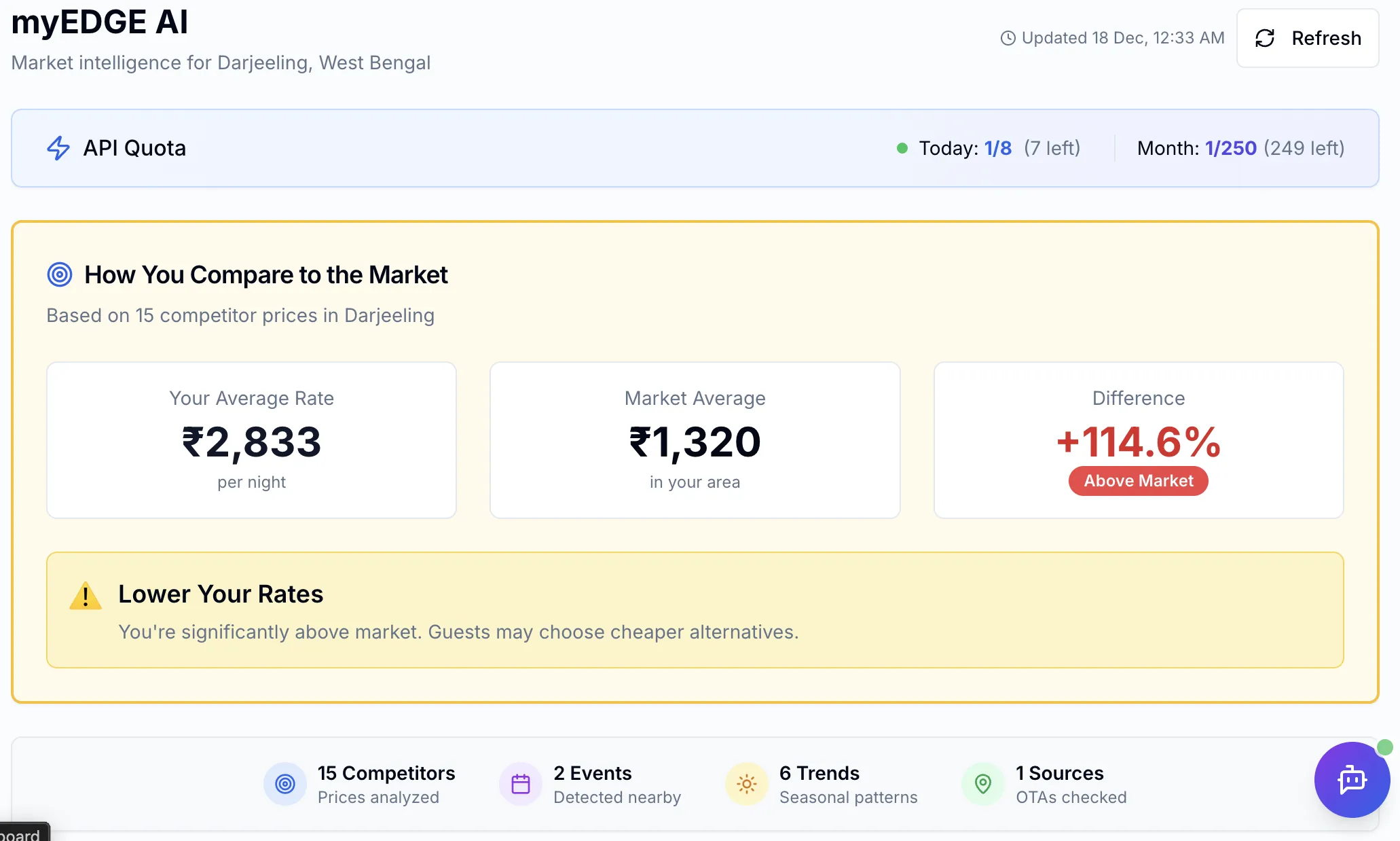
myEDGE AI · market position
Your average rate against the market average for your city, with a plain verdict — and the API quota you have left for the day and the month shown openly.
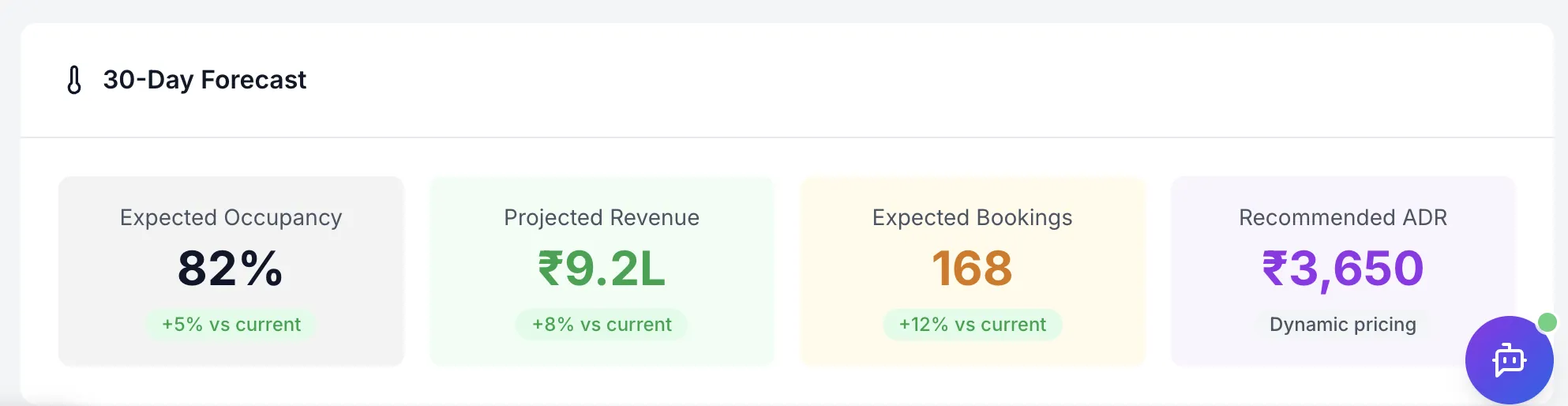
aiREV · 30-day forecast
Expected occupancy, projected revenue, expected bookings and a recommended ADR for the coming month, each against where you stand today.
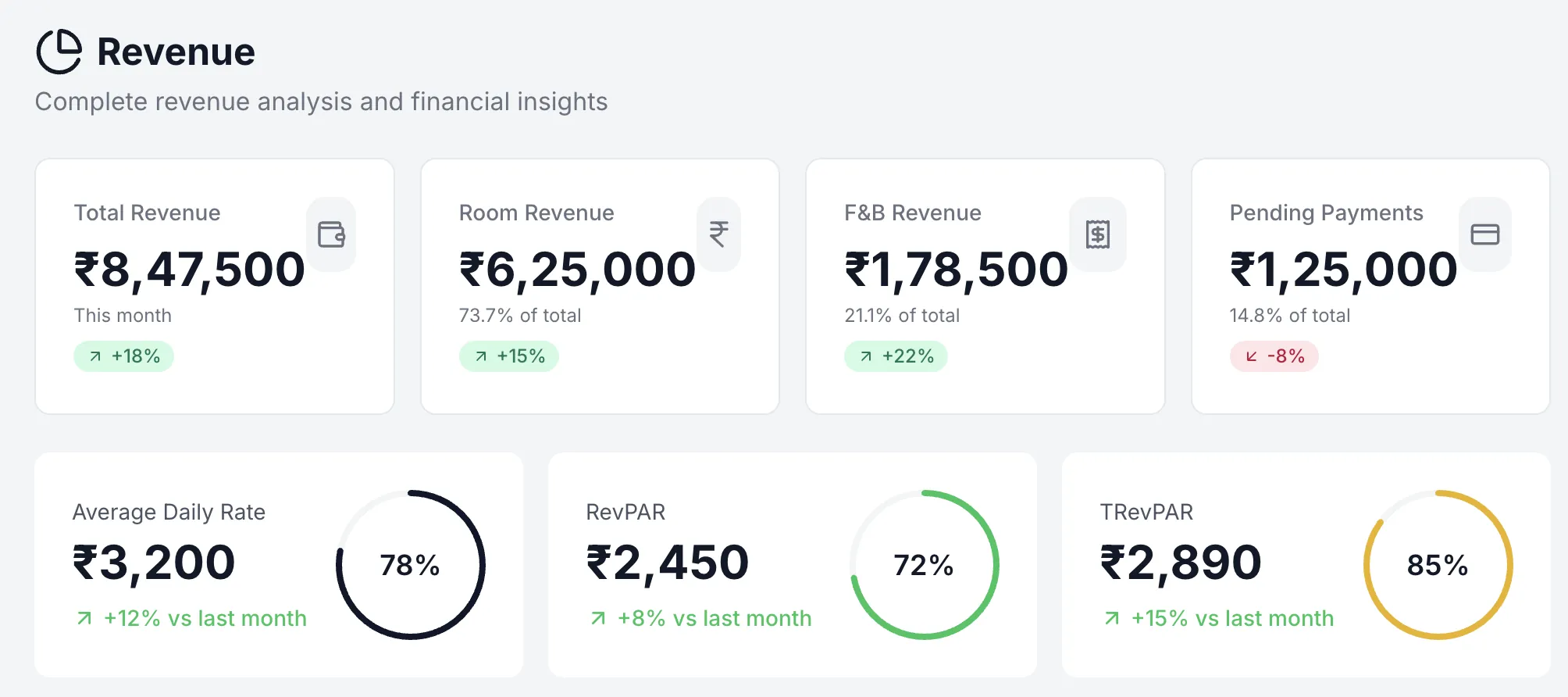
Revenue Dashboard · complete analysis
Total, room and F&B revenue with pending payments, plus ADR, RevPAR and TRevPAR against last month.
Module 01 · aiREV
A pricing engine you can argue with.
aiREV combines six signals into a rate for every room type and every date. The weights are published, the formula is published, and each recommendation carries the one reason that moved it most — “Event: Christmas week”, “Off-season adjustment”, “Below market average”.
- Recommendations are suggestions. Nothing is applied until you select it.
- Hard rate floor and ceiling per room type — the engine cannot cross them.
- Confidence score rises with your booking history, capped honestly at 95%.
- Every applied change is written to an audit log with its original reason.
Occupancy on the date + 90-day booking history
Month factor, 0.70 monsoon → 1.30 December
Saturday 1.20, Friday 1.15, Mon–Tue 0.90
Festivals and local events near the property
Last-minute premium, early-bird discount
Live competitor rates from myEDGE AI
rate = base × demand.30 × season.20 × dow.15 × event.15 × lead.10 × comp.10
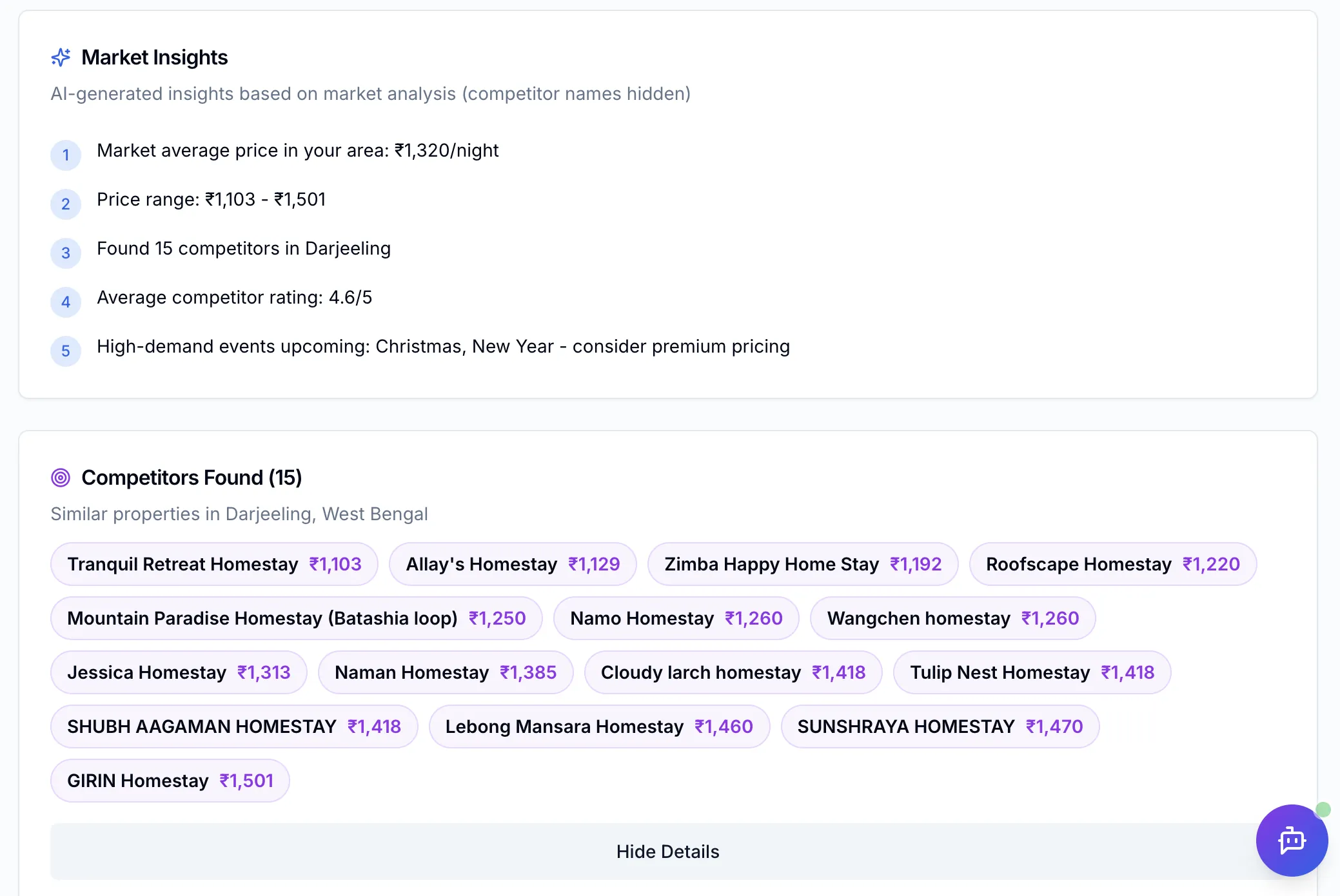
Module 02 · myEDGE AI
What the properties around you are charging, today.
myEDGE pulls live rates from multiple online sources for the five properties you actually compete with — price per night, star rating, rooms left, sold-out flags, active discounts and which OTAs are selling them. Prices arrive in USD and are converted to INR before anything is compared.
- Average Rate Index against the comp set, weighted by your real inventory.
- Amenity gap report: what most competitors offer that your listing does not.
- Festival and event calendar with the pricing impact for each occasion.
- Results cached for seven days so a paid quota is never burned on a refresh you did not need.
Module 03 · myhomeAI
Ask about your property, not about hospitality.
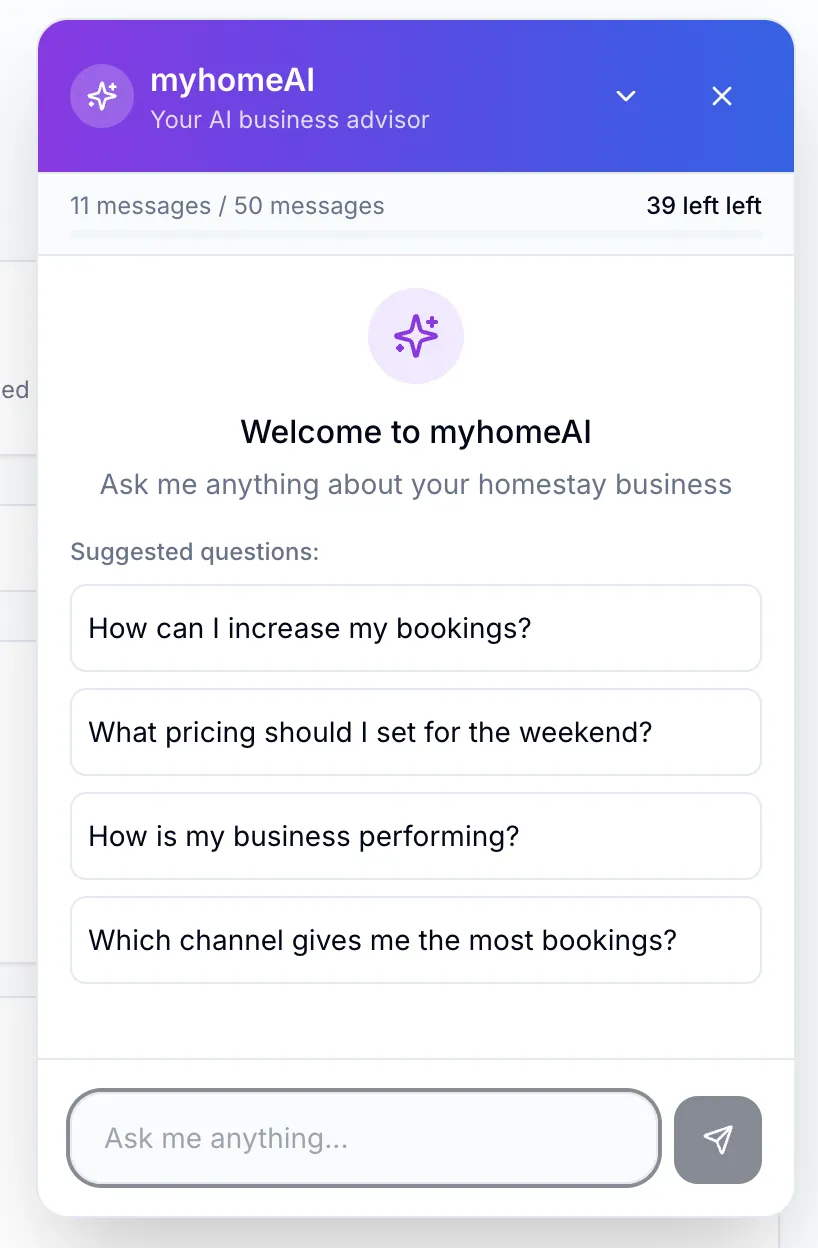
myhomeAI answers from your own bookings, rates, channels and guest history. Ask why last week was soft, which channel is quietly eating your margin, or what to charge on Saturday — and get a reply with your numbers in it, in ₹ and IST.
- Threaded conversations with streaming replies and per-answer feedback.
- Grounded strictly in the data belonging to your account.
- Usage shown as plain call counts, with a daily budget per account.
- Can be switched off entirely, per property or platform-wide.
Modules 04 & 05
Measure what happened. Then subtract what it cost.
The Revenue Dashboard holds the industry metrics and the forward view. Profit Analysis takes the same period and walks it down from gross revenue to what is left in the account.
Low estimate
₹18.4L
Projected
₹24.7L
High estimate
₹31.2L
Confidence band widens as history thins. Data quality: high
avg confidence 81%
GOPPAR
₹872
CPOR
₹1,704
NRevPAR
₹2,049
Industry definitions, not approximations
ADR, RevPAR, TRevPAR, GOPPAR, MPI, occupancy — each computed on sold and available room-nights, multi-room aware.
Pace, not just history
Where you stand for the next 30 days against the same window last year, and a forecast with an honest confidence band.
Commission made visible
Gross, commission and net per channel — plus the amount your direct bookings saved you this period.
Profitability by room type
Which rooms carry the property and which only look busy, using cost per occupied room rather than revenue alone.
Guardrails
An AI that runs your pricing should be easy to overrule.
Autonomy is a setting, not a default. Every part of the system is built so a property owner can inspect it, bound it, or turn it off.
Suggestions by default
Rates never change on their own. Auto-pricing exists, but it is off until you enable it and set the bounds it must respect.
Kill switches at three levels
Each AI module can be disabled per property, per feature, or platform-wide — and the switch stops the spend, not just the screen.
Metered and capped
Daily and monthly quotas on every external call, counted against actual usage so a shared paid quota cannot be silently drained.
India-first by construction
₹ formatting, IST cut-offs, DD/MM/YYYY, monsoon-aware seasonality, and DPDP-conscious handling of guest data.
- Rate bounds
- 0.65× – 2.00×
- Daily analysis
- 06:00 IST
- Comp-set cache
- 7 days
- Confidence range
- 50–95%
Or your own floor and ceiling per room type
Fresh recommendations before the day starts
Refresh on demand, within quota
Never claims certainty it has not earned
Getting started
Three steps to a priced calendar.
Connect your booking data
Sync from your PMS or channel manager, push through the REST API, or upload a CSV of the last 90 days. The engine starts producing recommendations immediately and gets more confident as history accumulates.
Set your bounds
Base rate, floor and ceiling per room type. Optionally a monthly revenue target. This is the whole configuration — the seasonality, day-of-week and lead-time curves ship calibrated.
Review each morning
A fresh set of recommendations lands at 06:00 IST with reasons attached. Apply the ones you agree with. Ask myhomeAI about the ones you do not.
See it run on your own numbers.
Bring 90 days of booking history. We will show you the rate recommendations, the comp set, and the profit waterfall it produces — before you commit to anything.