Module 01 · aiREV
The AI revenue manager that
shows its working.
aiREV runs an AI analysis over your bookings, your rate structure and the live market every morning, then produces a recommended rate for every room type on every date — with the reasoning attached. It never changes a price on its own. It makes a case, and you decide.
- AI analysis
- Reasoning model, daily
- Signals
- 6, published weights
- Autonomy
- Suggestion-only by default
- Bounds
- 0.65× – 2.00× base rate
The output
A rate, a reason, and a confidence score.
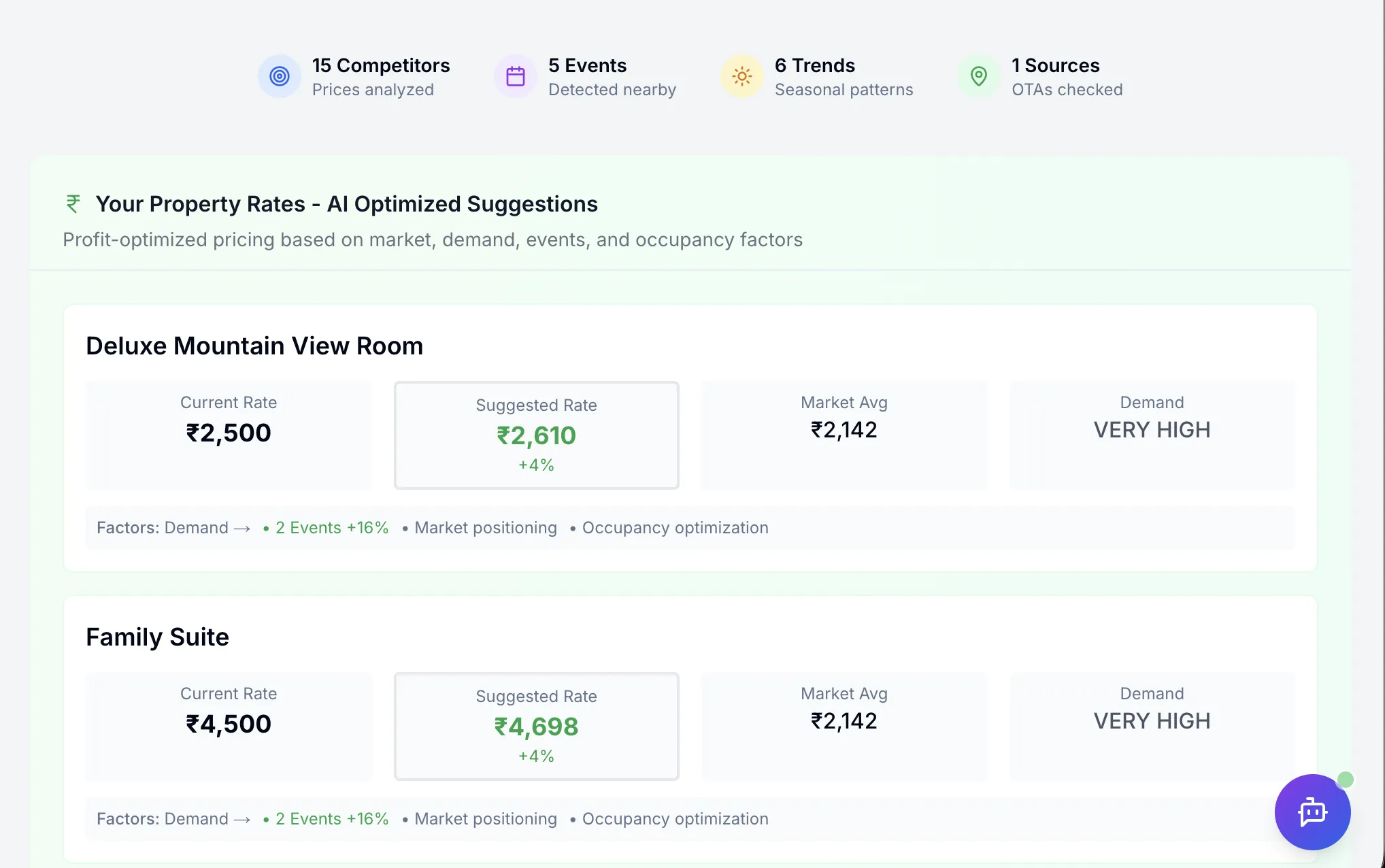
Every row is a decision you can accept or reject in one click. The old rate stays visible next to the new one, the delta is stated as a percentage, and the plain English reason is the single factor that moved the number most.
Confidence starts at 50% for a brand-new property and climbs with booking history, lifted further when fresh competitor data is available. It is capped at 95%, because nothing about next December is certain.
- Select any subset of recommendations and apply them as rate overrides.
- Recommendations expire rather than linger — stale advice is not advice.
- Ignored rows are recorded, so the engine is measured on what you rejected too.
- Every applied change lands in an audit log with its date, room type and reason.
Valley View Deluxe
Event: Christmas week · weekend premium
confidence 88%Garden Suite
Peak season · high demand (82/100)
confidence 84%Courtyard Twin
Low demand — attract bookings
confidence 71%Terrace Room
Monsoon off-season adjustment
confidence 66%Nothing changes until you select rows and apply them.
Apply selectedThe AI pass
The rate table is the output. The analysis is the product.
Every morning a reasoning model works through your last ninety days of bookings, your rate structure and room-type mix, the live comp set from myEDGE, and the event calendar around your property. It is looking for the thing you would have found if you had a full day to spend on it.
What comes back is not a number — it is an argument. An executive summary of where you stand, the insights that actually moved, and a short ordered list of what to do this week, each with the figures behind it.
- Predictive: demand and revenue projected forward with a confidence band, not extrapolated in a straight line.
- Comparative: your position read against a live comp set rather than last year’s benchmark report.
- Diagnostic: patterns surfaced that nobody queried — shortening lead times, a room type pricing itself out of its segment.
- Prescriptive: an ordered action list, sized to what one person can act on before the weekend.
Occupancy on the date + 90-day booking history
Month factor, 0.70 monsoon → 1.30 December
Saturday 1.20, Friday 1.15, Mon–Tue 0.90
Festivals and local events near the property
Last-minute premium, early-bird discount
Live competitor rates from myEDGE AI
rate = base × demand.30 × season.20 × dow.15 × event.15 × lead.10 × comp.10
The model
Six signals, multiplied — not a black box.
Each signal produces a multiplier around 1.0. They are combined as powers, weighted by importance, so a single extreme signal cannot run away with the price and a cluster of mild ones still adds up.
The result is then clamped to your rate bounds. If the model wants ₹9,000 for a room whose ceiling is ₹6,000, you get ₹6,000 — and you can see that the ceiling is what stopped it.
- Demand score
- Current occupancy (60%) blended with 90 days of booking history (40%), mapped to a 0–100 score.
- Lead time
- Under 3 days carries a 1.10 last-minute premium; beyond 60 days, a 0.95 early-bird discount.
- Events
- Festivals and local events, from your own calendar and from web search, capped so overlapping events cannot compound without limit.
- Comp set
- Live competitor average from myEDGE AI, clamped to ±20% so the market can nudge your rate but never dictate it.
Calibration
Built around the Indian travel year.
Most revenue tools assume a Northern-Hemisphere summer peak. aiREV ships with the curve that actually governs Indian occupancy: a December peak around New Year, the Diwali and wedding season through October and November, a Holi bump in March, and a deep monsoon trough in July and August.
Day-of-week works the same way — Saturday at 1.20, Friday at 1.15, Monday and Tuesday at 0.90. These are starting points, not commandments: they are visible, and a property with a different rhythm can shift them.
December peaks at 1.30. Peak monsoon bottoms at 0.70. Every factor is visible and adjustable — no black box.
What approval produces
An approved recommendation is just a dated rate override.
aiREV does not sell rooms or hold inventory — your PMS and channel manager keep doing that. What it produces is an ordinary rate override: fixed or percentage, scoped to room types and a date range, removable at any time. Suggested offers work the same way.
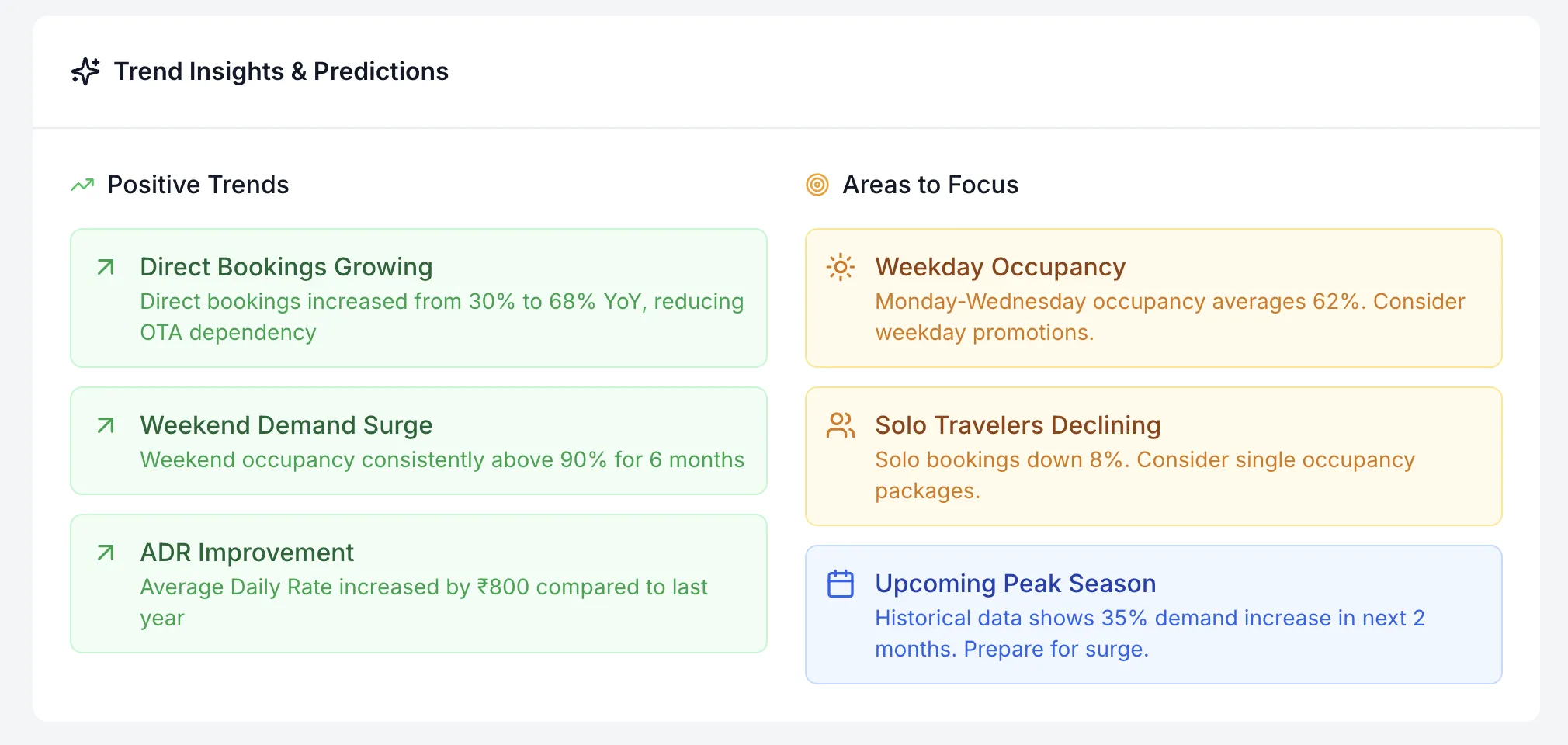
Trend insights and predictions
The AI pass splits what it finds into positive trends and areas to focus — direct bookings growing, weekend demand surging, weekday occupancy soft, a peak season approaching — each with the number behind it.
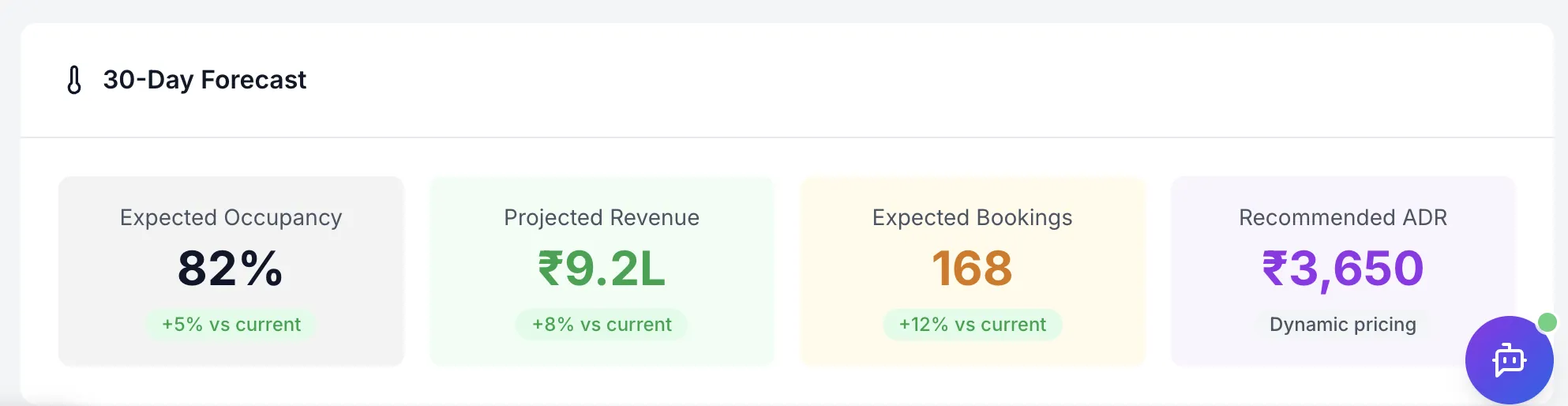
30-day forecast
Expected occupancy, projected revenue, expected bookings and a recommended ADR for the month ahead, each stated against where you are today.
Explainability
Eight reasons, in priority order.
When several factors point the same way, aiREV surfaces the most consequential one rather than hedging. If nothing is notable, it says standard pricing — it does not manufacture a narrative.
Event
A festival or local event overlaps the date — named in the recommendation.
High demand
Demand score above 70, from your occupancy plus 90 days of booking history.
Low demand
Demand score under 30 — the engine argues for discounting to fill.
Peak season
Seasonal factor above 1.15. In India that is Oct–Mar, peaking in December.
Off season
Seasonal factor under 0.85. Peak monsoon sits at 0.70.
Market position
Your rate sits more than 15% off the comp-set average, in either direction.
Weekend premium
Friday and Saturday carry their own multiplier before anything else applies.
Standard pricing
Nothing notable. The engine says so instead of inventing a story.
Beyond the rate table
Everything else aiREV does with the same analysis.
Demand forecast
Predicted occupancy by date and room type, with a demand score from very low to very high, so you can see the shape of the next quarter before you price it.
Revenue projection
Projected revenue for the horizon, broken out by room type and month, with the gap to your monthly target when you set one.
Suggested offers
Discount codes aimed at the specific soft dates the forecast exposes, rather than a blanket sale that discounts nights you would have sold anyway.
Overnight analysis
A full pass runs for every property at 06:00 IST. You can also trigger an analysis at any time when something changes.
Pricing audit log
Old rate, new rate, date applied, room type and the reason it was recommended — a complete record of how the calendar got to where it is.
Data-quality honesty
A new property is told it does not yet have enough history, instead of being shown a fabricated health score built on nothing.
Control
Autonomy is opt-in, and it is bounded.
Auto-pricing exists for owners who want it. It stays off until it is deliberately switched on, and even then it works inside the fence you build.
Off until you say otherwise
Out of the box, aiREV can only recommend. Turning on auto-pricing is an explicit action, per property.
Your floor and your ceiling
Set a hard minimum and maximum per room type. The engine clamps to them; it has no path around them.
Reversible by design
Applied recommendations become rate overrides with a date range. Remove the override and you are back to your base rate.
Measured after the fact
Forecast accuracy is logged against real room-nights sold, so the engine's track record is something you can check rather than trust.
Questions
What is AI revenue management for hotels?
- What is AI revenue management, and how is it different from a rate calendar?
- A rate calendar stores prices. AI revenue management decides them. aiREV reads your booking history, current occupancy, the live market around you and the events approaching, then produces a suggested rate for each room type with the factors that moved it named alongside. The rate calendar is where the answer lands once you approve it.
- Does aiREV change my rates automatically?
- No. Suggestions are the default and nothing changes until you apply it. Auto-pricing exists as an option, but it stays off until you deliberately enable it per property, and even then it is clamped to the rate floor and ceiling you set.
- How much booking history do I need before the suggestions are useful?
- About 90 days produces a usable confidence score on the first run. Below that the engine still runs, but it says so — a new property is told it does not have enough history rather than shown a confident score built on three weeks of data.
- What factors go into a suggested rate?
- Six weighted signals: demand at 30%, seasonality at 20%, day of week at 15%, events at 15%, lead time at 10% and the competitor set at 10%. They are combined as weighted powers so no single input can run away with the price, and the result is clamped to your bounds.
- Is the pricing model specific to India?
- Yes. Seasonality peaks in December at 1.30, carries the Diwali and wedding season through October and November, and bottoms at 0.70 in the July–August monsoon. Currency is rupees and days roll at IST midnight.
Bring 90 days of bookings. See what aiREV would have charged.
We run the engine over your own history and walk through the rates it would have recommended, the reasons it would have given, and where you would have been better or worse off.